Ecommerce Content Automation in 2026: Trends, Tools, and ROI
Discover the latest ecommerce content automation trends in 2026. Compare AI tools, learn implementation strategies, and measure the ROI of automation.
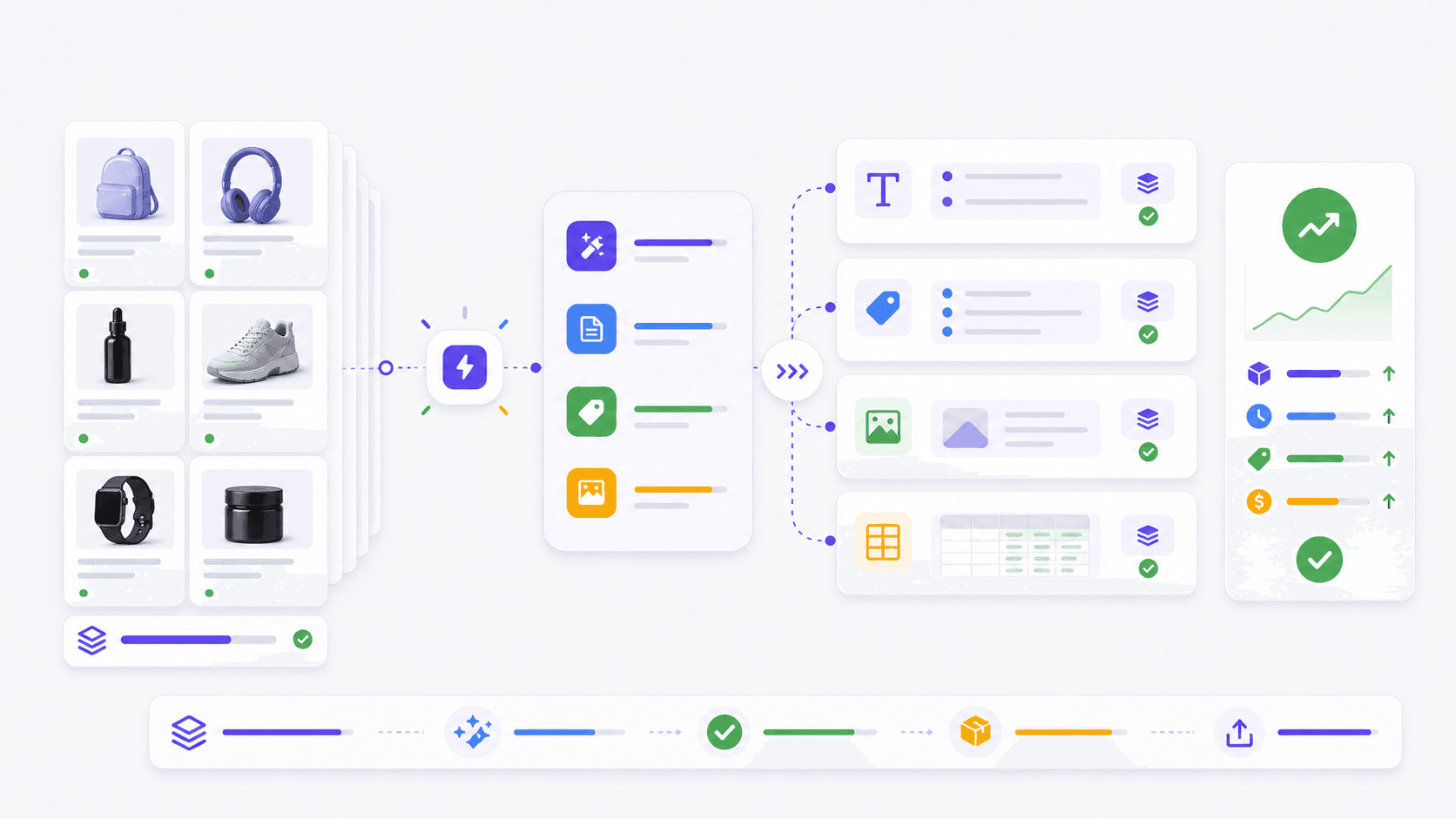
Ecommerce content automation uses AI to generate, optimize, and manage product content at scale. In 2026, it has become essential for stores competing in crowded markets.
Ecommerce content automation trends in 2026
The landscape has changed dramatically. Here are the key trends shaping content automation this year.
1. AI-generated product content is the norm
Three years ago, AI-generated product descriptions were a novelty. Today, they are standard. Most ecommerce platforms offer built-in AI tools. Third-party tools like Listo provide more advanced capabilities.
2. Multimodal content generation
Modern AI tools do not just generate text. They create image alt text, video scripts, social media captions, and email copy from a single product URL. One input produces multiple content formats.
3. Real-time content optimization
AI tools now analyze competitor content and suggest improvements in real time. If a competitor outranks you, the tool identifies what they do differently and recommends changes.
4. Brand voice consistency
Early AI tools produced generic copy. Today's tools learn your brand voice and apply it consistently across all content. This solves the biggest complaint about AI-generated content.
5. Integration with ecommerce platforms
Content automation tools now prepare content for Shopify, WooCommerce, WordPress, and other commerce surfaces. Shopify workflows often use copy-ready fields or CSV import, while WordPress and WooCommerce can support direct publishing when connected.
AI content tools comparison
Not all AI content tools are equal. Here is how they compare.
General-purpose AI tools
Tools like ChatGPT and Claude are versatile. You can use them to generate product descriptions, but they require manual prompting and formatting. They are best for occasional use or custom tasks.
Ecommerce-specific AI tools
Tools like Listo are built for ecommerce. They understand product data, Shopify formats, and SEO requirements. They produce content that is ready to publish without reformatting.
Platform-native tools
Shopify Magic and similar built-in tools are convenient but limited. They work within the platform's ecosystem and may not support advanced features like bulk generation or brand kits.
Which tool should you choose?
- Small store with few products: Platform-native tools may be enough.
- Growing store with 100+ products: Ecommerce-specific tools like Listo save time.
- Enterprise with complex needs: Custom solutions or API integrations.
How to implement ecommerce content automation
Implementation is straightforward if you follow these steps.
Step 1: Audit your current content
Before automating, understand what you have. Review your product pages and identify:
- Thin descriptions (under 50 words)
- Missing meta descriptions
- Duplicate content
- Missing image alt text
Step 2: Define your content standards
Decide what your product content should include:
- Description length (150-300 words)
- Tone (professional, casual, playful)
- Required elements (specs, benefits, call to action)
- SEO requirements (keywords, meta description)
Step 3: Choose your tool
Select a tool that fits your needs and budget. Consider:
- Output quality
- Shopify CSV workflow
- Bulk generation support
- Brand voice customization
- Pricing
Step 4: Generate and review
Start with a small batch. Generate content for 10-20 products. Review the output for accuracy, tone, and SEO quality. Adjust your settings and regenerate if needed.
Step 5: Publish and monitor
Publish the content and monitor its performance. Track:
- Organic traffic to product pages
- Keyword rankings
- Conversion rates
- Bounce rates
Measuring the ROI of content automation
Content automation delivers measurable ROI. Here is how to calculate it.
Time savings
Manual product descriptions take 15-30 minutes each. AI generates them in seconds. For a store with 500 products, that is 125-250 hours saved.
Cost savings
If you pay a copywriter $50 per description, 500 descriptions cost $25,000. AI tools cost a fraction of that.
SEO improvements
Optimized descriptions improve rankings. Higher rankings mean more organic traffic. More traffic means more sales.
Consistency
AI tools produce consistent content. Every product page has the same structure, tone, and quality. This improves the shopping experience and reduces confusion.
ROI calculation example
A store with 500 products saves 200 hours of work. At $30/hour, that is $6,000. The AI tool costs $500/year. ROI: 1,100%.
The future of ecommerce content automation
Content automation will continue to evolve. Here is what to expect.
Personalized product descriptions
AI will generate different descriptions for different audiences. A technical buyer sees specs. A casual buyer sees benefits. Same product, different copy.
Voice commerce optimization
As voice shopping grows, content will need to be optimized for voice search. AI tools will generate conversational descriptions that work with voice assistants.
Real-time content updates
AI will monitor market trends and update product content automatically. If a product becomes trending, the description will be updated to capture the traffic.
Cross-platform content
One product URL will generate content for Shopify, Amazon, social media, email, and ads. Each platform gets optimized content in its native format.
Conclusion
Ecommerce content automation is no longer optional. It is a competitive necessity. The tools are mature, the ROI is clear, and the barriers to entry are low.
Listo makes automation simple. One URL generates a complete content pack ready for Shopify copy/paste or CSV import. No store credentials are required to try the workflow.